

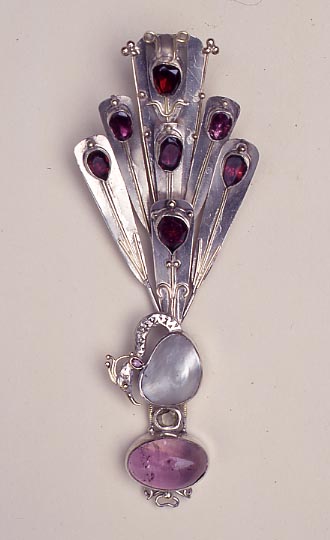
The Wilson holds a small but representative collection of jewellery by Arts and Crafts designers and makers. Many of these pieces were made by well-known designers such as C R Ashbee, who designed this peacock brooch in around 1900, but some were made by amateur makers. They share a number of principles. These, the principles of the Arts and Crafts Movement, could be applied to any craft, and jewellery was no exception. Many of the pieces were handmade in small workshops or by individuals working from home. They are often inspired by natural forms, such as animals and plants, and the designers also looked to the past for inspiration. The designs are often simple, particularly in comparison to earlier Victorian jewellery. They often designed pieces with elaborate symbolism.
This style, with its preference for silver over gold, and for semi-precious stones rather than rubies and diamonds, became fashionable. The jewellery was often worn with the simpler, less confining clothes favoured by reformers and artistic people, Many Arts and Crafts style pieces were made by commercial companies, such as Liberty’s of London.
Please note: The Wilson’s collection of jewellery is not currently on display. Please contact the museum if you would like more details.
1983.197
Silver brooch with gold wirework and stones to form a peacock designed by C R Ashbee and made by the Guild of Handicraft, 1900-1902.
The Wilson’s collection and Professor and Mrs Hull Grundy
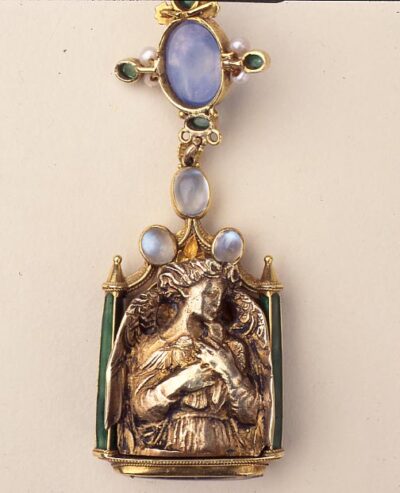
The majority of The Wilson’s collection of Arts and Crafts jewellery came as part of a gift from Professor and Mrs Hull Grundy. Professor Hull Grundy was a leading medical entomologist, studying insects that affect human health. He joined the Royal Army Medical College in 1942, and remained there for 25 years. Both he and his wife were collectors. Anne Hull Grundy started collecting when she was 11. Sadly, she suffered from a respiratory condition that left her unable to often leave the house, she devoted herself to the study and collecting of European jewellery. Later in life she and her husband gave generously to many museums up and down the country. She was a generous but very demanding donor ““ woe betide a curator who didn’t send a thank you letter in time! This piece, one of the most impressive in the gift, is by Henry Wilson, about 1908, in gold with moonstones and enamel.
1983.199
Pendant made of gold, enamel, pearl, opals and emeralds on a gold chain designed by Henry Wilson, 1908 to 1912.
C R Ashbee and the Guild of Handicraft
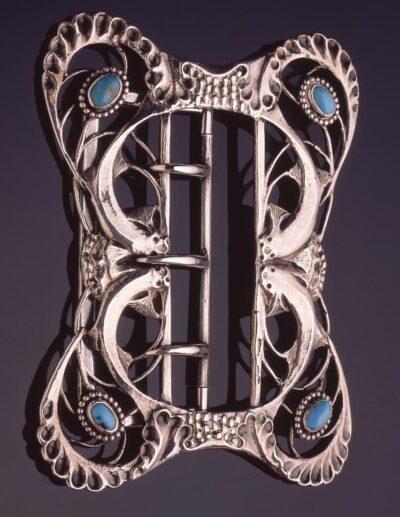
Ashbee became one of the most renowned designers of jewellery in the Movement. His designs were all made by the Guild of Handicraft, first in London’s East End, and, after 1902, in Chipping Campden. They were usually made in silver with colourful semi-precious stones, mother of pearl or bright enamels as decoration. He believed that the value of the piece lay in the design, not in how much the jewels were worth. He often designed pieces inspired by nature, a favourite animal was the peacock. These pieces are deceptively simple, but often have very fine detailing using wirework, filigree and pierced and chased silverwork. This buckle was an engagement gift to his wife, then Janet Forbes, in around 1895. It includes another favourite animal ““ entwined fishes, with turquoises.
1997.247
Silver buckle designed by C R Ashbee and made by the Guild of Handicraft, 1897.
Arthur and Georgina Gaskin
The Gaskins were originally from Birmingham where they both studied at the Birmingham School of Art, where Arthur later taught. In 1903 he became the Headmaster of the Vittoria Street School for jewellers and silversmiths. From 1899 he and his wife started making jewellery together, continuing working in the craft after moving to Chipping Campden in 1924. Georgina said of their working, ‘I did all the designing & he did all the enamel, and we both executed the work with our assistants.’ This piece from about 1911 is typical of their work, with its close packed leaves and flowers scattered with gemstones.
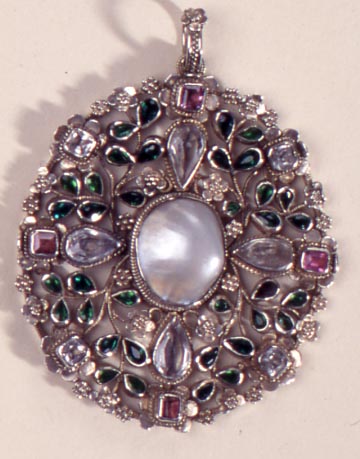
1982.1172
Oval pendant made from silver set with pearl, crystals and green pastes designed and made by Arthur and Georgina Gaskin, 1910 to 1911.
Designs for the Trade
There are a number of pieces by Liberty’s and other commercial manufacturers in the collection. Arthur Lasenby Liberty’s shop in London was originally an import house for Eastern textiles and goods, but in the 1890s they started making goods as well. They employed a number of highly skilled designers, such as Archibald Knox, but the pieces were not handcrafted. This meant that they were cheaper than those made by the Arts and Crafts craftspeople, and reached a wider audience. This silver buckle, 1899, is by Kate Harris, who designed for the Birmingham-based William Hutton and Sons Ltd.
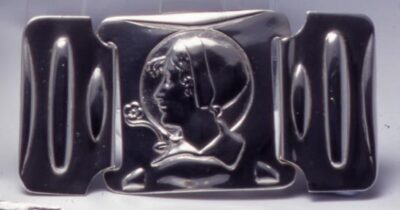
1982.1159
Silver buckle made in three pieces, the square central piece has the head of a girl in profile designed by Kate Harris and made by William Hutton & Sons, 1899.
Share this article
Follow us
A quick overview of the topics covered in this article.


