

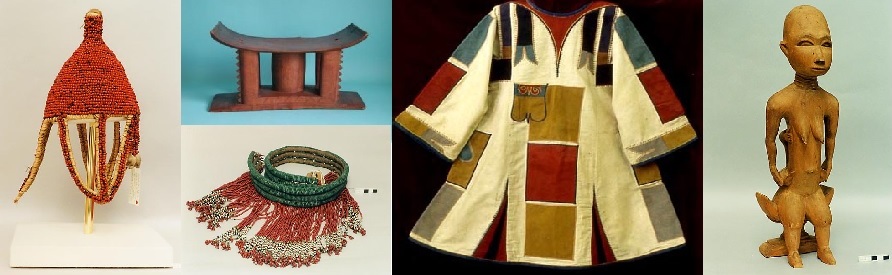
History of beadwork
Beadworking has been part of African cultural practices for centuries and is still widely practiced today.
Historically beads were made from natural matierls such as shells, or had been imported through trade with Arabic traders. European glass beads were introduced from the 15th and 16th centuries onwards by Portuguese and Dutch traders.The development of trade involved the exchange of valuable products such as gold, copper and ivory.
During this period, glass beads were incorporated into many artistic traditions around the world and were highly prized commodities. Traders viewed them as more valuable than the life of an enslaved person. This perception dehumanised enslaved people within a capitalist economy.
Over time glass beads became more available, leading to a marked increase in usage by the 19th century. And by the 20th century beadwork made a powerful political statement while as an expression of “traditional” precolonial African identity.
How did the objects get here?
South Africa became a formal British colony in the early 19th century. This was the result of violent military action, with land being annexed by the British. Conflict between the Africans and British continued throughout the 19th century and after the Anglo-Zulu War of 1879, the British enforced a change in lifestyle to the Zulu. This resulted in the gradual erosion of traditional dress.
Much of the beadwork held at the Wilson was donated by Cheltenham residents who had some connection to South Africa. These people would have acquired and donated these intricate works potentially without fully understanding the messages the beadwork communicates. This in turn means that the Wilson is still learning more about the collection today.
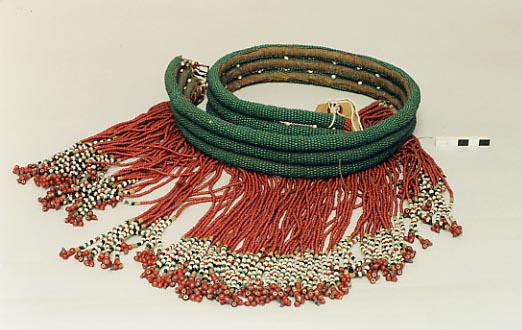
1933-46-1
Fringed waistband, isiheshe, Zulu people, about 1900
Share this article
Follow us
A quick overview of the topics covered in this article.


