

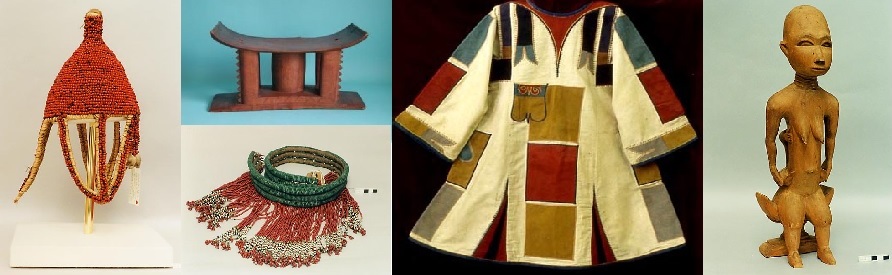
Robert Beasley was born in 1878, and attended Cheltenham College from 1892-97. In 1899 he obtained a commission in the Gloucestershire Regiment and departed for South Africa to fight in the Boer War. He was seconded to the West African Frontier Force (WAFF) from 1901-06 and took part in campaigns in northern Nigeria. It was during these years that he acquired his collection of edged weapons, armour and domestic items used by the indigenous peoples of the region. These were presented to the museum in 1933.
Sir Frederick Lugard had been entrusted with establishing British Government over the Protectorate of Northern Nigeria, yet the Emirs of Bornu, Bauchi and Yola openly defied Lugard’s authority. The newly formed WAFF, made up of a small band of British officers like Beasley, and a rank-and-file of Yoruba, Hausa and Nupe people from Nigeria, was sent out to subdue the Emirates’ forces. The setting for the conflict was the Savannah of northern Nigeria. The heat was intense, soldiers were plagued by mosquitoes, flies, fever and dysentery; if that was not enough the WAFF faced a fearsome enemy in the Emirates’ elite troops.
The British used soft-nosed, ‘dum-dum’ bullets, illegal by the 1899 Hague Convention in ‘civilised’ warfare, but deemed fit to use on socalled ‘savages’. The Emirates used poisoned arrows and spears in contradiction of Islamic Law. Their justification was that the poison was prepared by their non-Islamic neighbours.
By the time that Beasley left Nigeria in October 1906, the country had been ‘subdued’. In 1914 the north and south formed to become the country of Nigeria which gained its independence from Britain in 1960. Beasley, who acquired the nickname ‘Bronco’, survived his west African exploits to serve in Ceylon, and in World War I, earning a DSO with two Bars. He went on to command the 2nd Battalion of the Gloucestershire Regiment and died in October 1954.
1999-136
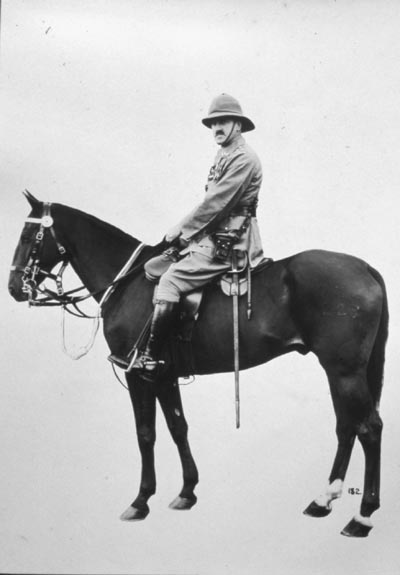
Portrait of Robert Beasley, taken at Jhansi, India about 1928
Share this article
Follow us
A quick overview of the topics covered in this article.


