
The Cheltenham StoryHesters Way Public Art Trail

Hesters Way is an area in the west of Cheltenham, built mainly on former farmland after the Second World War to provide much-needed housing. It includes neighbourhoods such as Springbank, Arle, Fiddler's Green, Rowanfield, St Mark's, parts of St Peter's and the Moors. Today, it is home to around 20,000 people in over 10,000 homes. In the 1940s, The Cheltenham Corporation was given powers to compulsorily purchase land, and a huge area to the west of Cheltenham was surveyed. By the late 1940s, the land had been purchased, often in smaller blocks, from the Arle House estate, Arle Court Farm, and Hesters Way Farm – this is where the name of the areas came from. The large main road running through the area was called 'Princess Elizabeth Way' as the then Princess Elizabeth planted a tree in the estate in 1951 to mark its official opening.
Many of the homes in the area were built as a Wimpey no-fines council area, referring to a specific type of concrete used to build the houses. Some of the housing, such as Scott House and Edward Wilson House were built to house GCHQ workers sent to the area by the Foreign Office. Coronation Square, the central shopping focus of the area was built 1958-61, with the final buildings in the area being completed in 1965. Building in Springbank commenced the same year, with the Fiddler's Green area development beginning in 1977. The area of Hesters Way, Benhall and Springbank has been at the centre of recent development with the GCHQ 'Doughnut' opening in 2004. As we look to the future this development continues with the build out of Golden Valley Development, including the nationally important Innovation Centre.
Hesters Way Public Art Trail
The area has been the focus of redevelopment since the 1990s. For example, India and Pakistan House, two eight-storey blocks of flats which suffered several fires, were demolished in 2006, replaced with more modern and safer houses and flats. In 1997 the Hesters Way Partnership was formed, this became the West Cheltenham Partnership in 2021. This partnership has been fundamental in working to empower the local community and develop sustainable local community initiatives.
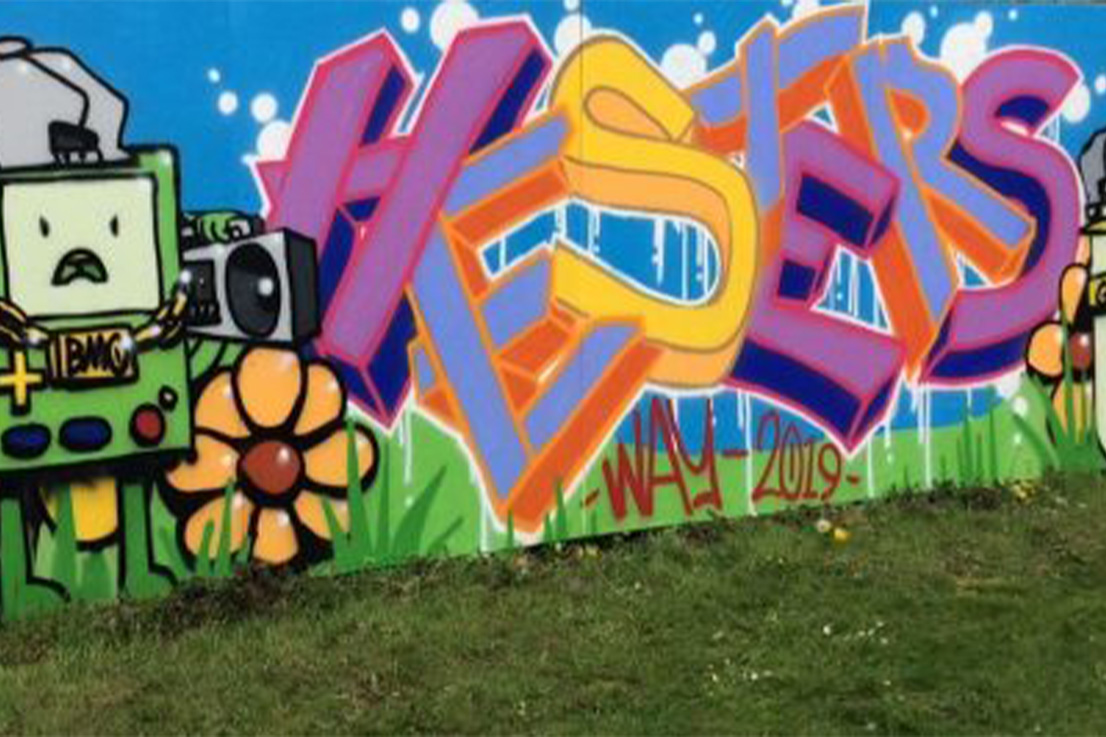
One of their most high-profile projects is the West Cheltenham Public Art Trail. The trail is a 1 hour, 5km walking trail around the area that takes in a mixture of public and community art works. The first piece is a mosaic found on the wall of Hesters Way Community Centre which was made by David Bowers, an artist who specialises in community projects across England and Wales. He worked with five local groups to complete the piece. One of the more recent additions can be seen in King George V playing fields. Called 'The Listening Dragon', it was completed by Rob Olins in 2019 and was inspired by designs submitted by the local community. Other notable pieces include the 'Story Chair', designed and completed by sculptor Natasha Houseago as a place for locals to tell and record their stories of life in the area, and the 'Listening Stones' by Gordon Young, installed in Hesters Way park in 2004.
Find out more about the trail and view the interactive map.

Things to see nearby
St Mark's – Cheltenham's national housing scheme
Accessed from the Hesters Way area via Gloucester Road, the St Mark's National Housing Scheme area can be found. Built in the wake of Lloyd George's Housing Act of 1919, which saw the clearing of slums to build better quality housing. The housing was built on land purchased from the Arle Court Estate. Work began on 22 April 1920, with several of the roads being named after famous poets. The area has its own distinctive early 20th century architectural style, which is just as much a part of Cheltenham's identity as the Regency and Victorian architecture found elsewhere.
Princess Elizabeth Way Cheltenham Paint Festival artwork
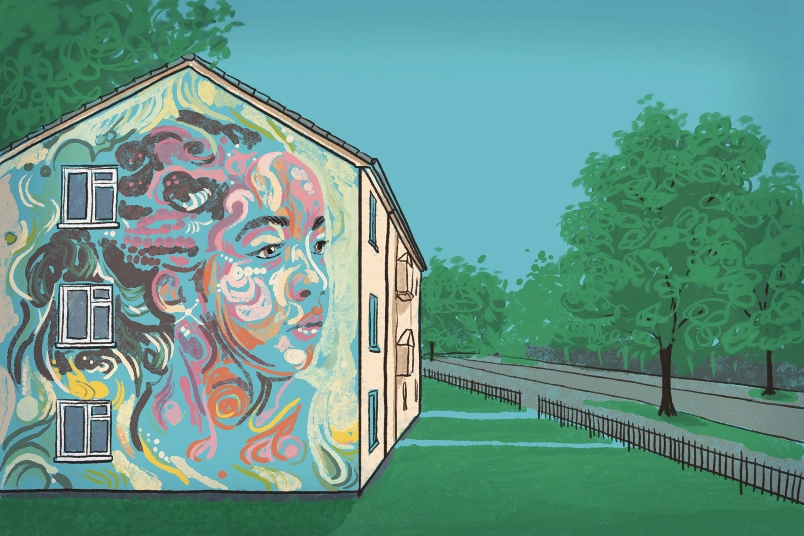
Princess Elizabeth Way also features several pieces of artwork on the side of buildings, completed as part of the yearly Cheltenham Paint Festival. Works include two Asian influenced paintings by Dan Kitchener, known as "DANK", on the sides of Arundel House (2019) and Kenilworth House (2020), and a piece by Jody Thomas, an award-winning Bristol-based artist, on the side of Sudeley House. Visit Cheltenham Rocks to view interactive map of the artwork in this area and across Cheltenham.
Heritage Index
Interested in discovering more about the history of Cheltenham? Explore our Heritage Index for a rich collection of research, stories, and resources to help you continue your own journey into the past.
Thanks for our partners and sponsors