

TocH was named after Talbot House, a rest place for soldiers fighting in the trenches. It was the vision of two army chaplains, Neville Talbot and Phillip ‘Tubby’ Clayton. Their aim was to establish ‘an everyman’s club’ where ranks did not count, and friendship could be fostered across social boundaries. The soldiers shortened the name to TH, and then in the radio signallers’ language of the day, Toc H.

Talbot House was at Poperinge in Belgium, a few miles back from the trenches around Ypres, conveniently situated for soldiers to reach. It belonged to a hop farmer and had a large kitchen, a garden, and a library. Soldiers could borrow a book by leaving their cap behind as a ticket. There was a chapel in the attic where regular services were held. Talbot House offered an oasis of sanity through the war. In 1930 it was bought by the TocH movement and can be still visited today.
When the war ended ‘Tubby’ Clayton wanted to open a new Talbot House in the UK where the fellowship and camaraderie of the original house could be continued. He gathered a group of men who had been to Talbot House during the war to plan the enterprise. They decided to drop the name of the original house, as there was already a place of that name in South London, and instead to adopt the soldier’s nickname of TocH as the new name for the movement. Although TocH was only open to men, there were some nurses who had known Talbot House in the war. They set up a League of Women Helpers to support TocH’s work. They took a very active role during the Second World War, when again many men were away fighting. The two groups merged in the 1970s.

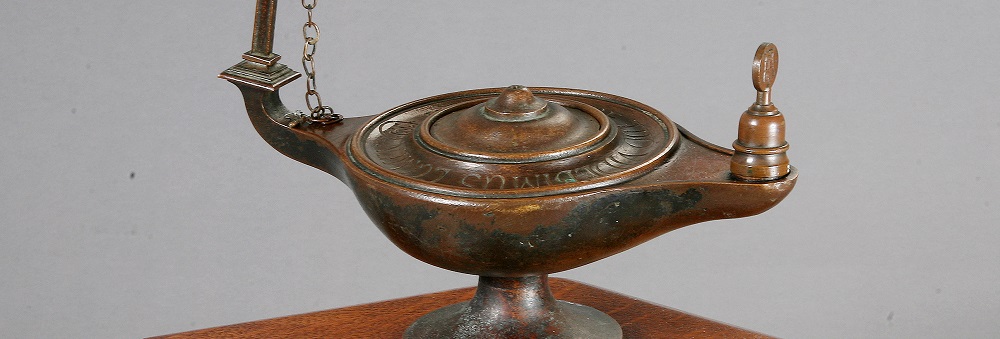
The Cheltenham branch began in 1920 at the instigation of Revd Pat Leonard, the Chaplain of Cheltenham College. Meetings were held at the Spinning Wheel Café on the Promenade. The lamp, known as ‘the lamp of maintenance’, was lit at every meeting in a ‘Ceremony of Light’. Members took it in turns to perform the ceremony. A half minute of silence was observed to remember those who had died in the war. The ‘Ceremony of Light’ was the idea of the Cheltenham Branch and was taken up nationwide, and later worldwide.
In its early days TocH members carried out social work. They ran holiday camps for children, helped the elderly and sick with gardening, made hospital visits and assisted people who were ill or disabled. The first ever talking newspaper was a TocH project, and the founder of the Samaritans, Chad Varrah, was a member. TocH believed that ‘Service is the rent we pay for our room on earth’. The group continued to meet in Cheltenham until 2003 when dwindling numbers forced its closure.

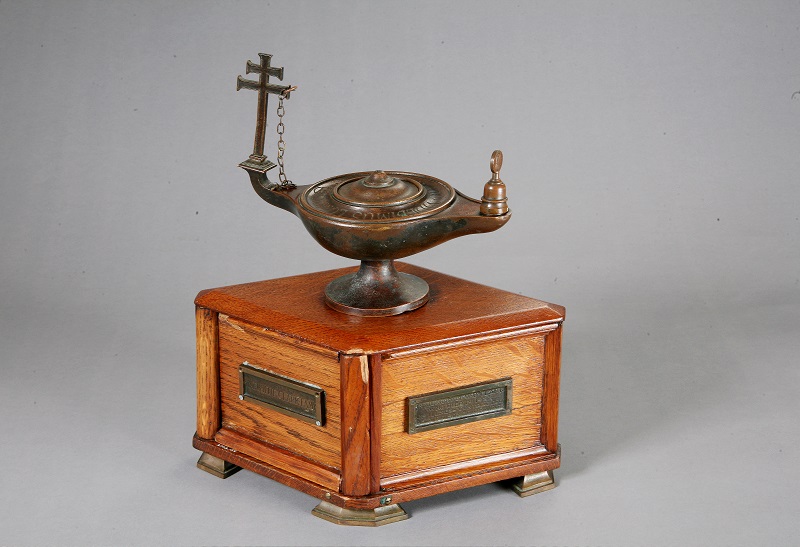
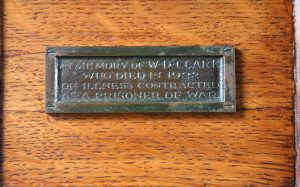
This lamp was lit at meetings of the local TocH group to remember those who had died in the First World War. It is made of bronze, and has a purpose made wooden carrying case. The finials and wick can be taken out and stored inside the box, along with the lamp. It was presented to the Cheltenham Branch of TocH on the 15 December 1922 by the Prince of Wales at the Guildhall in London. The lamp is dedicated to the memory of WD Clark of Cheltenham who died of illness contracted as a prisoner of war.
When a branch closes, the TocH lamps are usually returned to headquarters for melting down, but Eric Varley, the last secretary of the local branch, asked if this particular lamp could be given to the art gallery and museum. It is especially significant given Cheltenham was the town that introduced the ceremony of lighting the lamp.
1989.213-300×200
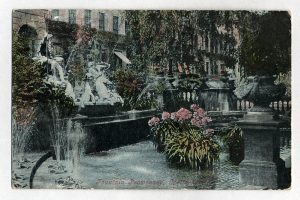
The Cheltenham TocH branch was at the Spinning Wheel Cafe, near the Neptune Fountain on the Promenade.
2003_159_002
Cheltenham's TocH lamp, 1922
2003_159-detail-4-300×187
Detail of one of the plaques, showing dedication to WD Clark
Share this article
Follow us
A quick overview of the topics covered in this article.


