
The Cheltenham StoryBrewery Complex
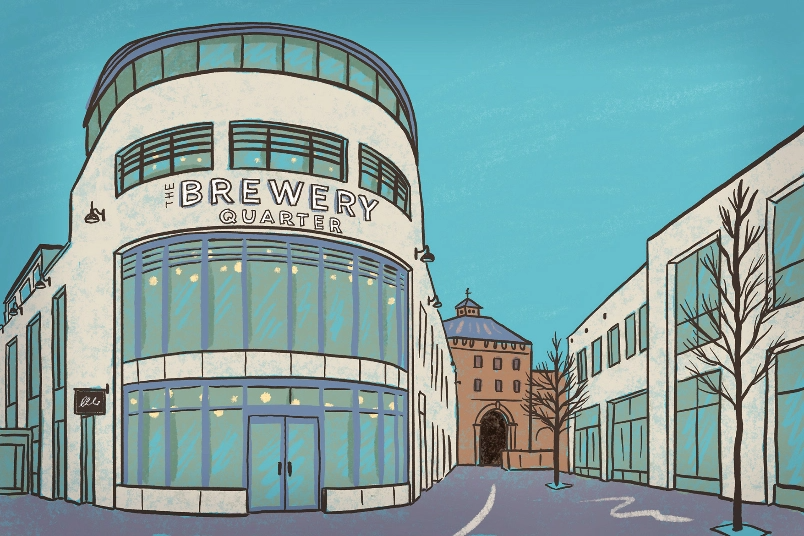

Malting and brewing had been undertaken in Cheltenham and the surrounding areas as a cottage industry, a manufacturing business carried out in people’s homes, since Medieval times. Before the invention and implementation of sewers and water treatment systems, drinking water was often contaminated and unsafe to drink. This made alcoholic drinks, even if only mildly alcoholic, the safer option. The first major commercial brewery was founded near the High Street in 1760 by Thomas Gardner, a local maltster and baker. It became known as Gardner’s Brewery, it was evidently very successful as the site was enlarged by 1818, and again in 1884. A fire at the brewery in 1887, which started in the hop room, burnt down a sizeable portion of the original building and machinery. It caused an estimated £50,000-£60,000 worth of damage (between £5-6million today). William Bradford and Sons rebuilt the complex to be more fireproof.
In April 1888 the business was registered as Cheltenham Original Brewing Co. Ltd., which gradually took over several other breweries in Cheltenham, Gloucestershire, Worcestershire and Herefordshire. The name changed to Cheltenham & Hereford Breweries in 1946, before being acquired by Cheltenham Brewery Holdings Ltd in 1956. The name changed again in 1961 when it became West Country Breweries Ltd. At that point, the brewery had 1275 tied houses, pubs which were owned and controlled by the brewery and were only allowed to sell their drinks. The brewery was acquired and renamed for a final time in 1963, when it was bought by Whitbread & Co. Ltd and became known as Whitbread Flowers Ltd.
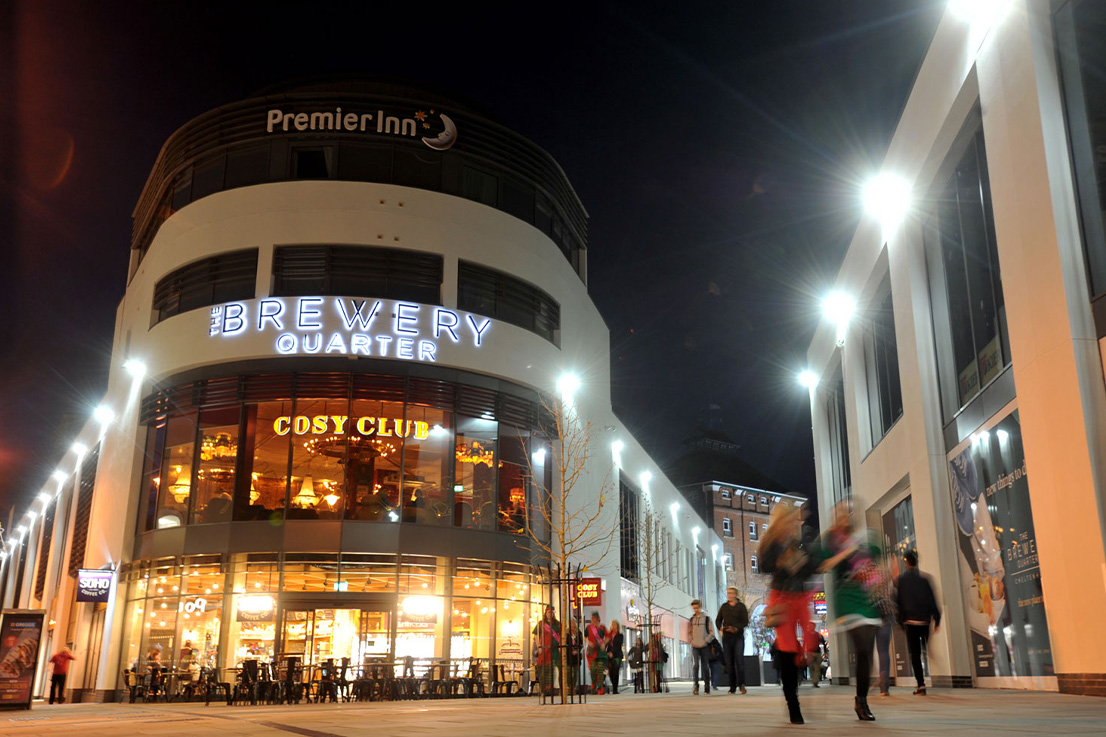
Brewery Complex
Brewing ceased at the site in 1998, although many Cheltonians can still recall the smell of the hops that was particularly pungent when travelling up the Lower High Street. The site was redeveloped, and although many of the buildings were demolished, several were incorporated into the new Brewery Quarter Complex. During the regeneration, several of the empty buildings were used to host art activities and pop-up exhibitions in collaboration with The Wilson Art Gallery and Museum. The site first re-opened in May 2006, undergoing a second major development and expansion in 2017. It is now an area filled with shops, restaurants, bars, leisure activities and even a gym. The site also regularly features live music performances and even has its own Christmas light switch on ceremony.
This regeneration of the old brewery buildings means that the site has been in almost continual use for more than 250 years, contributing to a major part of Cheltenham’s history, economy and identity.

Things to see nearby
The Winston Churchill Memorial Garden
Starting off life as 19th century burial ground, the Winston Churchill Memorial Garden is a 1-hectare park tucked away behind the Lower High Street towards the junction with Tewkesbury Road. The garden has existed since 1965, and contains an area sown for wildflowers, a lavender garden, decorative trees, and a patio with a mosaic water fountain encompassed by words and drawings collected from the local community. There is a children’s play area created in 1990 with help from children from nearby Gloucester Road Nursery and Primary School. For history lovers, there is the Grade II listed St Mary’s Mission, built in 1831 and originally a burial chapel. The garden provides a link to the Honeybourne Line cycle track.
The Honeybourne Line
The Honeybourne Line is a green walking and cycle track along a closed section of the Great Western Railway line. It currently runs from Cheltenham Spa station through to Tommy Taylor’s Lane and Pittville Park, as well as the town centre (near Waitrose and the Lower High Street) and on through to Wymans Brook. Not only does it provide several kilometres of cycle and walking routes, but it’s an important wildlife corridor, providing a habitat for butterflies, bees and other insects in the native plants found along the route. Several of the tunnels and walls along the stretch display beautiful artwork completed by renowned street artists as part of the Cheltenham Paint Festival. The council provides route maps of the Honeybourne line, along with information on other green spaces around the town, here.
Heritage Index
Interested in discovering more about the history of Cheltenham? Explore our Heritage Index for a rich collection of research, stories, and resources to help you continue your own journey into the past.
Thanks for our partners and sponsors