
The Cheltenham StoryLives of Colour
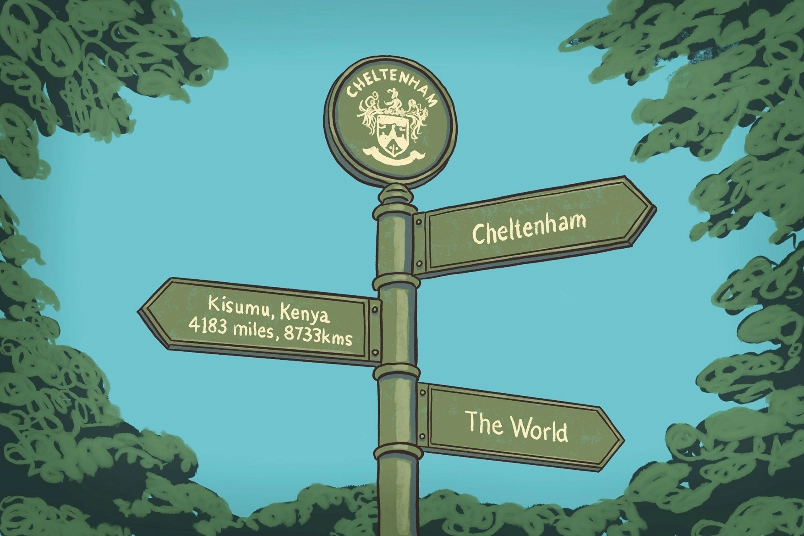

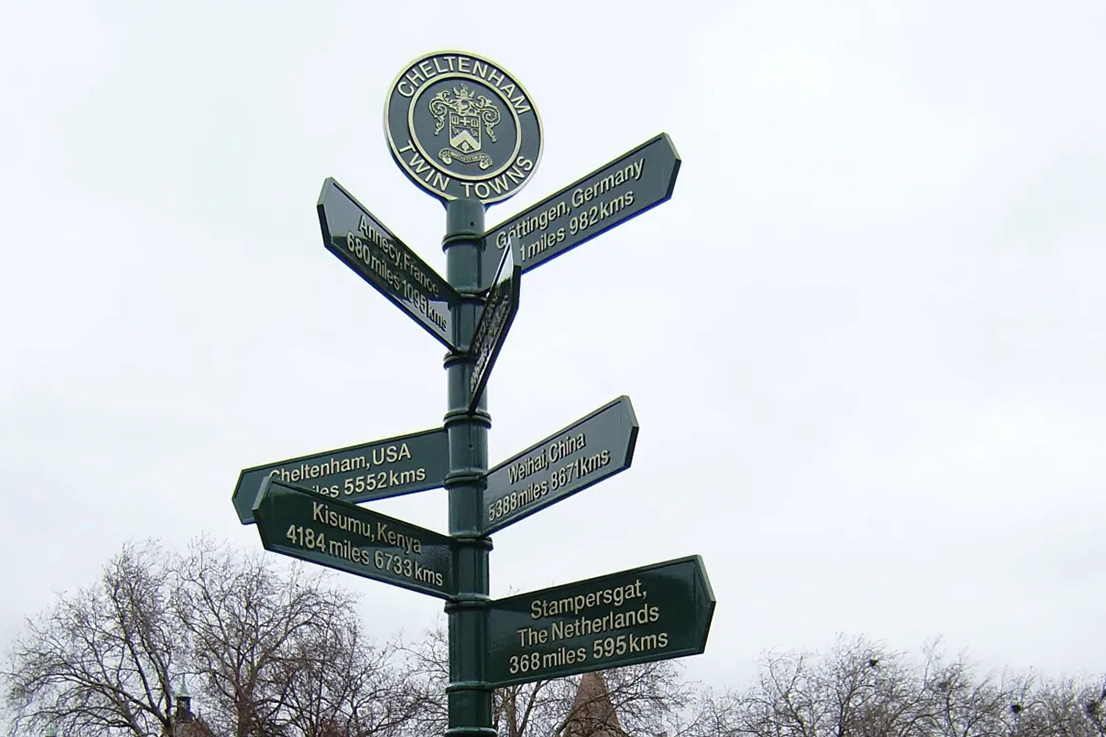
You are standing by the signpost that displays all of Cheltenham’s twinned and friendship towns. In 1985, Cheltenham became a friendship town with Kisumu in Kenya. The aim was to promote cultural, social, and economic collaboration by developing a closer friendship between the towns, acknowledging the great contribution the black and minority ethnic communities were making to the town that they had migrated to. It has seen the exchange of youth and adult groups, mainly focusing on environmental projects and resulting in ongoing links with Gloucestershire schools and colleges.
This is the story of one individual, Lameck Ondego.
Lameck moved to the UK in August 1989, for a higher education opportunity, being accepted into West London College. From being mesmerised by the tube, to feeling as though everything he needed was available, Lameck was amazed by the technological advances of the UK, but the experience of living in a new and unfamiliar culture was full of challenges.
Growing up in Kenya, Lameck describes a belief that the UK was a place where money grew on trees, a place of opportunity and prosperity, so the sight of people begging for money on the streets was a shock.
Originally, Lameck intended to stay in the UK for 2 years to study before moving back to Kenya but ended up deferring his degree for a year so that he could work.
Lives of Colour
He writes, ‘when you move somewhere new there is no direction or someone telling you what to do which means there is a need to find your people and support system’. Lameck remembers how the Kenyan community would come together and amongst themselves share their problems and struggles to collectively find a solution.
Although settled in England, Lameck felt there were some who did not make him feel welcome. He does not think he has directly experienced racism, but he has felt it. He doesn’t understand how someone’s existence can affect others so much. His rationale is that he was not taking opportunities away from anyone “I’m not taking your job, your wife or your house. If I’m not taking your space, why should my pure existence bother you?” Lameck remembers other ethnic communities beginning to migrate to the UK and how these groups would become the target of the same discrimination. He thought to himself “How many jobs can one person do?”
Lameck moved to Cheltenham in 1996 to join his friends Oscar and Tony, drawn by the charm of the town. He worked at the Paragon Laundry on Hatherley Road, which introduced him to a new circle of friends, making the transition even more memorable. He studied at the University of Gloucestershire and was a youth worker at The Rock. The arrival of a son in 1998, and a daughter a few years later, started a new chapter for Lameck that blended family, friendship and deep appreciation for the town he had come to love. Both children are dual heritage, embracing both British culture and his Kenyan heritage.
Although this is one individual’s history, it is also the lived experience of thousands. A key takeaway from Lameck’s story is that “We have the same brains, we all bleed blood, we have the same ability”.
This story was contributed by Lameck Ondego and Lives of Colour, a local organisation that focuses on elevating the voices of ethnically and culturally diverse communities for equitable futures.
Find out more about Lives of Colour.

Things to see nearby
Cheltenham Town Hall
The Town Hall, a Grade II listed building, was built at the beginning of the 20th century, replacing the Assembly Rooms which had previously stood on the High Street. When the Assembly Rooms were converted into a bank, the council took the opportunity to create a new and larger venue that could host the many balls, concerts, and social events that filled the town’s lively calendar throughout the year. The building was designed by Gloucester architect Frederick William Waller and constructed by local Cheltenham builders Collins and Godfrey. Created in a Classical style to complement the surrounding architecture, the exterior features an arcaded gateway once used by horse-drawn carriages, along with impressive Corinthian columns. Inside, visitors can admire a beautifully decorated coved ceiling and a sprung floor specially designed for dancing. The Town Hall officially opened on 5 December 1903, with construction costs totalling £65,000 — the equivalent of almost £7 million today. Now managed by the Cheltenham Trust, the Town Hall continues to host a wide variety of concerts and events, including performances and activities connected with the Cheltenham Festivals. It is also home to the Tourist Information Centre, located in the foyer.
Visit websiteEdward Adrian Wilson Memorial Statue
Located on the Promenade, in the Long Garden, is a bronze statue of Dr Edward Adrian Wilson, commemorating his death in Antarctica in 1912 on Captain Robert Falcon Scott’s ill-fated Terra Nova expedition to reach the South Pole. The statue was designed by Edith Agnes Kathleen Young, Lady Scott and later Baroness Kennet, a prolific sculptor who trained in London and Paris. She has been described as the most prolific woman sculptor before Barbara Hepworth. Baroness Kennet’s first husband was Captain Robert Falcon Scott, who also perished in Antarctica with Wilson. The statue was funded by money raised via public subscription. The stone plinth was provided by L. Boulton and Sons, stone masons who worked on many buildings in the town, including Cheltenham College. The statue received cleaning and restoration work in 2012.
Heritage Index
Interested in discovering more about the history of Cheltenham? Explore our Heritage Index for a rich collection of research, stories, and resources to help you continue your own journey into the past.
Thanks for our partners and sponsors