
The Cheltenham StoryParachute Jump
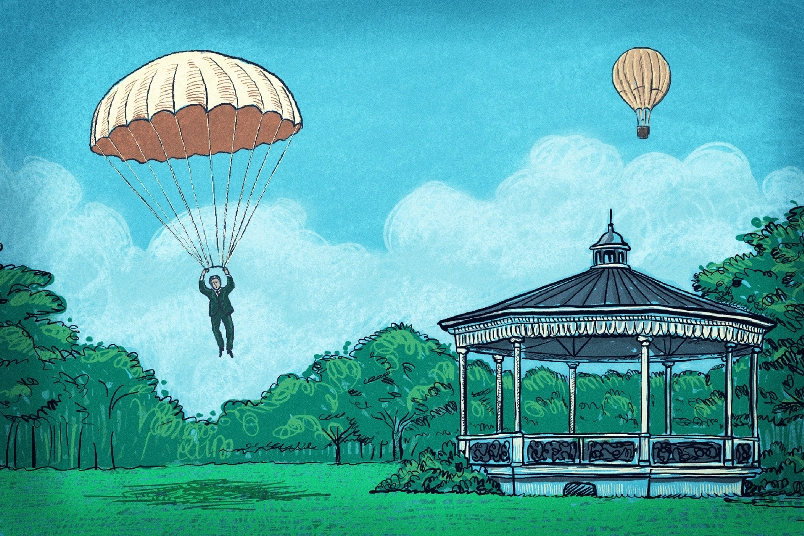

3 October 1838 saw an exciting day in Montpellier Gardens. John Hampton made the first successful British parachute descent, after jumping from a hot air balloon from a height of around 9000ft/2743m. The parachute itself was made of canvas over a framework of whalebone ribs and bamboo stretchers, attached by a copper tube to a small wicker basket.
The jump didn’t go entirely without issue. The town council had only allowed Hampton to make his jump if the balloon remained tethered in the gardens, but he cut the rope once it reached 300ft. After Hampton made his jump at 9000ft, he barely escaped with his life when the balloon exploded. He later described the descent as starting so rapidly that it knocked the air out of him before his parachute fully inflated and the descent slowed down. In total, it took him 12 minutes and 40 seconds to fully descend, landing with only a small scratch to his forehead. He landed in Badgeworth, approximately 3.5 miles away from where he began the jump.
Today, the spot where Hampton began his ascent is marked by a plaque on the bandstand in the gardens. The plaque, funded by the British Parachute Association and the Cheltenham Civic Society, was unveiled on 3 October 2008 to mark the 170th anniversary of the jump.
Montpellier Gardens
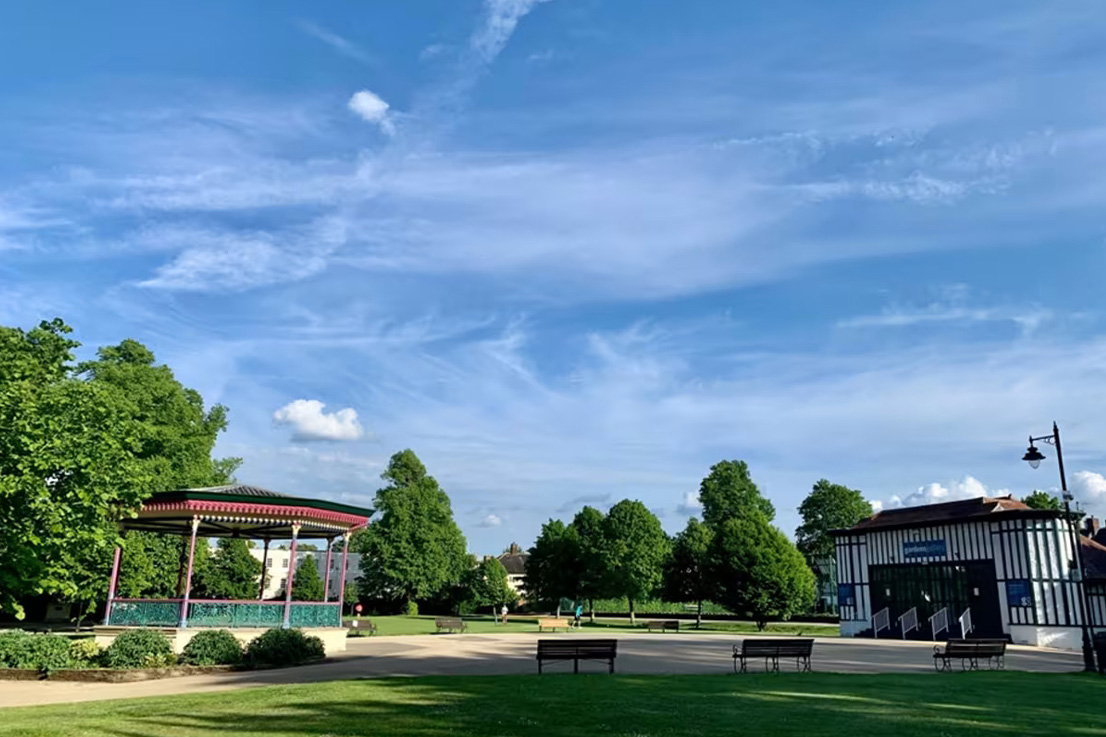
The Montpellier Gardens also have an interesting history. They were created in the early 19th century as pleasure gardens, and were part of Henry Thompson’s Montpellier estate, known as Trafalgar Field before the purchase. Thompson discovered spa waters in the area and constructed a simple wooden pump room. It became so popular that eventually it had to be knocked down and replaced with a grander spa building which was designed by George Allen Underwood, who also designed the Masonic Hall on Portland Street. The Pump Room was topped with a large dome designed by J. B. Papworth, known as The Rotunda, which was inspired by Rome’s Pantheon. The building had a concert hall upstairs, where the famous Swedish opera singer Jenny Lind performed in 1848. The building is now occupied by The Ivy restaurant.
By the 1830s, visitors to the gardens could, for an admission fee, enjoy such sights as a glass house filled with exotic plants, an ornamental fountain, and a Chinese pagoda. It was frequented by many British nobles including the Duke of Wellington. The bandstand was built in 1864, holding regular concerts which proved extremely popular with visitors. It was restored by the Civic Society in 1994.
A new chapter began in 1893 when Cheltenham Borough Council purchased the spa and gardens for £7400, and it became free for public use. Tennis courts were built, and it was the home of the Cheltenham Croquet Club until 1920. Other sports such as lawn tennis and archery were also introduced.
Today, Montpellier Gardens remain at the heart of Cheltenham life - not only as a beautiful green space, but also as a venue for the town’s festivals, such as the Jazz and Literature festivals. From family picnics to world-class performances, the gardens continue to be a place where the community comes together.

Things to see nearby
Caryatids
Montpellier Walk is home to 32 caryatids (sculptural female figures made as part of a column) based on classical models from the Acropolis, Athens. They date from 1843 and have inspired the area’s nickname – ‘Armless Walk’. The two originals were sculpted in London by John Charles Felix Rossi, whilst the copies were made by local Cheltonian James Brown of 45 Tivoli Street, who also worked on Pittville Pump Room and Cheltenham College Chapel.
Montpellier Arcade
Built in 1832 by local architects Robert and Charles Jearrad, Montpellier Arcade is one of the first purpose-built shopping arcades in the whole of the UK. It was designed to provide shoppers with a chance to browse stores while under cover from the elements. In 1845 it housed ‘Mr Brown’s snug and coffee and cigar divan’ in the space now occupied by the bar John Gordons, where gentlemen would go to drink hot chocolate or coffee. Women would only have been allowed to drink tea at the time, as anything else would be seen as ‘impolite’.
Heritage Index
Interested in discovering more about the history of Cheltenham? Explore our Heritage Index for a rich collection of research, stories, and resources to help you continue your own journey into the past.
Thanks for our partners and sponsors